According to the "Insanity Test" conducted on the Battle for Gallion's Reach game manual and the game shop site, the manual still needs some work. Rating a 45 out of 100, it is clear that the manual is lacking in a few important areas such as illustrations demonstrating examples of actual play and game set-up.
On the up-side, the game's shop site was rated as well-done and serves as a good advertisement for the game.
I am hoping to get this manual re-done and ready for publication very quickly, but obviously, this project will take more time to get right. A fair assessment of when the game will be ready for sale is that it is another month away.

SERIOUSLY FUN GAMES!
Monday, April 21, 2014


Friday, April 18, 2014
Games UPDATE
Battle for Gallions' Reach
As of today, Battle for Gallion's Reach is undergoing what is called: "Insanity Testing". This is lingo used in testing computer software. What it means for our game is that the publisher is testing our game manual and the shop website for our game for any problems or issues. Once we hear back from the testers and make any required fixes, a proof copy will be printed. It will take about a week to receive this copy and then we will examine it in detail. If all looks well, Gallion's Reach will be placed on sale! We are hoping that we can get it up for sale withing two weeks at the most. It all really depends on the Insanity Test and the final proof.Our Next Game: Inherit the Stars
After much work we have decided to develop the Inherit the Stars game next. In fact we are starting preliminary design and play testing. It seems this title is coming together quickly! In fact we would like to have this game fully play-tested and proofed and in the market by the middle of this summer!Inherit the Stars actually harks back to the initial design for Gallion's Reach. But instead of focusing on star ship combat, we have decided to concentrate on economics, nation-building, nation relations with combat being only one means of winning a game.
So far we are really pleased with this one! We believe that it will fill a niche in science-fiction based strategy gaming. I do think we have a "winner" on our hands!
We will be putting regular updates here about both games.
Wednesday, April 9, 2014
What Are We Playing?
While creating games takes up most of the time available, we enjoy playing games and doing so gives us the ideas and knowledge of what makes an enjoyable game. We have been gaming since the 1970's and gaming has changed a great deal since then. Most strategy games today are very card-driven where once they were very dice and chart driven. While I'm still a fan of having winners and losers, many newer games always provide a means of the loser to stay in the game so no one is expected to leave the game and end up watching his friends play. Also, there have been new mechanics in game design today to eliminated clutter and bookkeeping. I feel the literacy rate has dropped so low that rules and mechanics need to be simple and streamlined.
So what games are we playing these days and which games would we like to play?


So what games are we playing these days and which games would we like to play?
MEMOIR '44
This is a great game for the novice or the experienced gamer who just wants a casual semi-tactical World War 2 war game. The game moves fast and smooth. There are handy reference cards that help players find the modifiers for movement and range. The game takes real World War 2 battles and presents them in a very abstract manner - albeit with "cool" plastic army-men playing pieces! Play is heavily card-driven - so much so that the random factor is perhaps a bit too strong and takes away a good deal of the ability to plan your own strategy. This is not a game for simulating World War 2 combat but a fun way to play some famous battles in a very light and casual way. And there are many, many scenarios and expansion sets from every theater in the war from Russian Front, Western Front, North Africa, Italy and the Pacific. Most games are short - from one to two hours at most. The larger board and scenarios for it can double that time, but makes for an even better gaming experience.
CONQUEST OF EMPIRE
Using a HUGE board - almost 4' x 4' - and up to seven players, Conquest of Empire is a risk-like strategy game that covers the time of the Roman Empire in an abstract way. There are four types of units: Legions, Cavalry, Catapults and Galleys (ships) and they are led by Generals and Caesars. Players have a "home" territory and then start expanding out and gathering territories so they can make revenue to buy troops. Roman-looking plastic money is the means by which you makethose purchases, but you'd better buy early because, like the Roman Empire, inflation starts making those armies very expensive! It's a great game with very simple rules (for the basic game) and much more complex rules for the advanced game. My only complaint is that the cavalry have a very un-historical influence in the battles and too much survivability. Legions are the standard units, while cavalry allow you to pursue your enemy if they choose to, or must, retreat from battle. Catapults help you capture walled cities. Players build roman roads from cities you build to collect revenue. The basic rules are VERY simple and the advanced game rules are VERY advanced. It would be nice to have some intermediate rules that gave a more historical feeling to the games without the complexity, but this is a fun one for up to seven casual players and, like memoir '44, it uses "cool" plastic miniatures - which always adds to the "gee-wiz" factor!
I have personally created a few historical scenarios using the basic rules such as the Caesar vs. Pompey Civil Wars as well the later civil wars. I've also introduced barbarians into the mix (albeit using the Roman pieces) to introduce another power historical factor into the game.
AXIS & ALLIES 1942
Axis & Allies has so many titles covering the Second World War (and a new one covering the First World War) that it may be hard to choose which game to actually start with. There are excellent reviews of the various games on You Tube that I highly recommend before buying any of them. However, the 1942 incarnation is a newer product that uses updated rules. It's a fun, basic-to-moderate level game. Once you understand the movement and combat system the game is fast playing (although setting up can take some time!). It can be played by two to four players, and again, the "cool" factor returns with those plastic miniatures!
STAR TREK FLEET CAPTAINS
While an expensive product ($75), the reviews for this game are superlative! It is a very fun and enjoyable game! It really puts you in the Captains chair and lets you conduct typical Star Trek missions. This one I'd really like to have!
STRIKE OF THE EAGLE
Using a unique command/orders card driven mechanic and wooden blocks for fog-of-war, Strike of the Eagle looks like a game I would really love to play. All reviews are highly positive. It simulates the battles of 1920-21 when the Soviet Red Army invaded Poland in it's attempt to convert, by force, all of Europe to Communism. The Poles single-handedly beat off the invaders and saved Europe from the Communist horde.
AXIS & ALLIES D-DAY
Using a re-worked version of the Axis & Allies rules, this very simple and direct game that "simulates" the Normandy invasions in 1944. This is a good game for casual play and is heavily card-driven. A nice game to have handy for play with those who aren't "war gamers".
COMMANDS & COLORS NAPOLEONICS
This is supposed to be the bast "Command & Colors' game out there. Even better than the "Ancients' versions. From the same designer of Memoir '44, this game is less abstract and has excellent rules to play many Napoleonic battles. There are expansion packs for the Austrian and Russian armies. This is one I very much want to have.
AXIS & ALLIES PACIFIC
I love the Pacific theater so this one looks like a blast to play. Uses and enormous board and modified Axis & Axis rules. Definitely on my "must have" list.
STAR TREK ATTACK WING
If you ever wanted to command a starship in combat this is the game for you. Using a unique non-board movement system, players take on the roles of starship captains from Star Trek lore. Characters from the TV show appear and you get three decent plastic miniatures of the well-known Federation, Klingon and Romulan ships. There are expansions for the large variety of aliens and ships in the television show and movies along with a single mission for each. The price is right and the reviews are highly favorable! This is certainly one for every Trek-head's collection!
Wednesday, April 2, 2014
Inherit the Stars artwork
Working on the idea for this title led to some preliminary artwork. I thought I'd share these ideas now that I've been bold enough to announce this game on the blog.


On the map corners are the Costs Charts for buying a building things such as Starfleets, etc. The circles represent sub-regions as part of larger regions (represented as colored lines around groups of sub-regions). the Sub-regions are where the game pieces move to and from. They use the lines that connect them (Jump Routes) to move from one to another. Each sub-region is controlled/shared by different players and there are three types of sub-regions that determine how many and what type of habitable worlds are potentially available for colonization. The larger Regions are used for random events and for "historical"scenarios delineating where various political entities exist or once existed.

Preliminary box cover concept art
Some of the Race-Related Game Pieces
Representing from L-R: Homeworlds, Colonies, Starfleets, Battlefleets, StarLegions (armies), Starbases (stations). At the very bottom are pieces representing the Homeworld, Colonies and ships belonging to the dangerous Nanomachines which will be autonomous forces without a human player and which will operate according to a set of strict rules.
Game Map Board
This is the entire game map made up of twelve 10"x16" sections (for ease of packaging, setting up and for use with smaller scenarios) making a 4' x 3'-6" total map size. The entire galaxy is represented as seen from the galactic north and looking "down". The galaxy is broken into regions, sub-regions, with galactic geography, and jump routes. The image is a high resolution Hubble Space telescope image of a very distant galaxy similar to what scientists think ours looks like (although we can't know for sure since we are embedded within it).On the map corners are the Costs Charts for buying a building things such as Starfleets, etc. The circles represent sub-regions as part of larger regions (represented as colored lines around groups of sub-regions). the Sub-regions are where the game pieces move to and from. They use the lines that connect them (Jump Routes) to move from one to another. Each sub-region is controlled/shared by different players and there are three types of sub-regions that determine how many and what type of habitable worlds are potentially available for colonization. The larger Regions are used for random events and for "historical"scenarios delineating where various political entities exist or once existed.
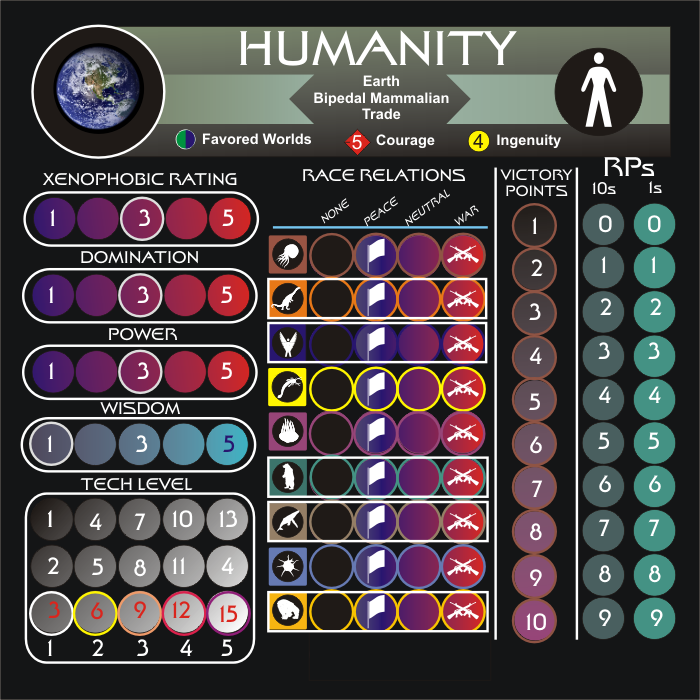
Player Race Records Mat
Each player selects a race to play (based upon personal appeal) and then uses one of these charts to keep track of the game as it plays. Each race is different and plays the game a bit differently. Some races have higher levels of Wisdom (which determines how many cards they can draw and play from the deck each turn), Xenophobia (ability to get along with alien species), Domination (how well captured enemy populations behave under enemy occupation), Influence or "Power"(the ability to project influence to neighboring sub-regions). the Influence (power) category includes such things as overall military ability, propaganda effectiveness and cultural appeal and is used to lure nieghboring alien colonies into becoming joined to your civilization (as well as helping to calm occupied colonies and prevent Revots). The Tech Level determines the things the player can do. It helps determine how many spaces a Fleet or StarLegion can move in a turn, how powerful they are in combat, the overall Influence (Power) level, Victory Points (for some players), effects on Race Relations and how effective exploration of a sub-region is in looking for colonizable worlds. There are places for showing what the relations are with each other race in the game are: None, Peace, Neutral or War. What sort of worlds are favored for habitability, Courage level (used in combat determination) and Ingenuity which is used in determining advancing to higher Tech Levels and shown as well. Higher ingenuity helps a player gain higher technology levels. Also, listed under the Homeworld name and the biology of the race, is the means for that race to win the game. For example, advancing Trade with other players is the fastest and most direct means for a Human victory.
Sample Game in Progress
In this example of early game-play there are four players. The human player is in the upper center in Olive Green. The humans have successfully colonized three regions and one of their Starfleets has discovered some Ancient Knowledge which will boost the Human Tech Level points. However, the Humans are finding themselves surrounded in at least two sides by alien races also looking for colonizable worlds in their direction.
To the Human's left, they have made contact with a race called the Vargr (in Red). As a race, the Vargr are a naturally aggressive species, so this first contact might not end well for the Humans. In fact a Vargr Battlefleet is on it's way to that region to enforce it's claim to to any worlds there. A "Contested Space" marker has been placed there, and will remain there as long as both races share the same space and no war has been averted. If war is averted, the marker is removed and unless one of the races prefers different World types to settle on, one of the players will have to evacuate the region entirely. The Humans are natural traders, so they may be able to prevent a war and at least establish a "Neutral" relationship with the Vargr. Perhaps one where trade between the races will lower tensions between the two. However, Humans have a moderately high Xenophobic Rating with can easily lead them into conflict with races that are physiologically different from them (truly "alien"). It is fortunate that the Vargr resemble earthy apes, so the Xenophobia rating will likely be reduced and peace will result.
To the Humans right, the Ursa race (in Green) is expanding their direction quickly. The Ursa are moderately aggressive and very territorial and win the game by having more colonies, so the chance of war between these two is high - unless the Humans can also establish trade with them.
Toward the galactic core another race called the Hurc (in Blue) is expanding and they have no immediate neighbors except, perhaps the Humans. The Hurc are intelligent "octopus-like" lifeforms and therefore truly alien to the Humans, Vargr and the Ursa, so depending on the Xenophobia ratings of each, things can get hairy.
Fortunately, races can attempt to adjust their various ratings (except for Ingenuity, Favored Worlds and Courage - which always remain the same). These races can attempt to modify their innate tendencies toward aggression and cultural dominance.

A Closer Look at the Section of the Game in Progress
If the humans play their cards right they could eventually set up trade hubs with their neighbors which will allow Cultural Centers to then be established which would lower the chances of war and give victory to the Human player. But random events can occur to spoil the best of plans and the Humans have no control over the natural desire of their neighbors to play nice.
Near the Galactic Core and to the immediate right of the Hurc, a Supernova has exploded which contaminates all the immediately surrounding and connected sub-regions until the radiation effects die down. If the explosion had happened closer to the Hurc one of their colonies would have been extinguished. Supernova are extremely rare events but very deadly. Only a Tech Level 5 civilization can reduce the effects of a Supernova.
More artwork coming soon!
Comments and suggestions are welcome!!!
Tuesday, April 1, 2014
INHERIT THE STARS

While deciding which of the five game titles we were looking at to produce next after Battle for Gallion's Reach, seems that one new idea has come out a winner...possibly. I say possibly because things change and this concept may turn out to be less of a "winner" once we really start to examine it as a game...not just a "good idea".
After looking at the board game market these days, there are lots of world war two games on the shelves which can mean two things: 1) It's a popular subject and therefore a good candidate for a title or 2) the market is glutted OR 3) While there may be many titles, perhaps a unique "take: on the subject could help another one stand out from the pack. This is the realm of the market researcher. Not particularly the most exciting of activities but it has the virtue of being critically important to help ensure your product has a decent chance of succeeding.
We are fortunate that we are actually IN the target market for these games we produce so we know exactly what is liked, but I have always had a hunch that people should try and make things they would like to have themselves.
And I have learned to agree with my hunches!
So, after looking at the current market, there is still a wide open and burgeoning market for science fiction oriented titles.
After studying the most popular titles out there and looking at the various ideas that I have come up with I believe I have a "winner"....or at least a runner up for the prize.
The concept is called "Inherit the Stars". It's a BIG game but can be played in smaller bytes based on the scenarios played and the number of players one can corral up on any given "game night".
We've even dome some preliminary artwork, (posted soon!)
From 2-10 players.
On a map board of the entire galaxy which is broken into separate regions, players start with an early starflight-capable civilization with specific traits and colonize the stars. Along the way, they meet other civilizations that are similar or very different from them. Rather than concentrating on space combat (like Battle for Gallion's Reach) Inherit the Stars will feature other ways to win such as a having a dominant culture, creating a Galactic Council and voting which player is to be the Galactic President (6-10 player games only), defeating the Machines (a malevolent autonomous race of intelligent nano-machines), having peaceful relations the longest, and of course, controlling the most regions.
The idea is that, unlike Gallion's Reach, players are actually going to be running their own unique civilizations and trying to deal with the challenges of colonizing, exploring and forming relationships with alien species who are also doing the same things. Gallions' Reach concentrated on combat and conflict and very specific technologies and ship to ship combat, while Inherit the Stars generalizes technological and starship combat at a macro-level. the idea being that players are not destined to fight one another and in fact, peaceful cooperation can benefit some. While this might sound boring, there are enough challenges, such as natural disasters, plagues, revolts, hostile autonomous alien races and surprises due to exploration to keep everyone riveted and busy. Achieving a high victory point total wins the game and each species will gain points differently than others. For example, Humans will gain more points for creating Trade Hubs and Alliances. Some races will gain more points for conquering other races by war. Some will do better by concentrating on colonizing as many regions as they can - which means a utilizing a combination of diplomacy and war. Each race will have it's own unique and specific ways of achieving victory.
Each race will have a Xenophobic rating which determines how friendly it is with aliens, a Species Rating that will determine which alien species it can co-exist and cooperate with the best, character strengths such as propensity for research, war, peace or trade and which sorts of planets they prefer to colonize. In fact, this last propensity can allow different species to co-exist in the same region of space without conflict.
There are going to be scenarios taken from a game that I developed many years ago (but never published) in which 2-6 players can play over the course of a couple of hours or less. these scenarios cover the history of the galaxy as the various races spread out and came into contact with one another. Some can be played in a hour and others might take a couple of evenings of play.
But I want to keep the essential game rules simple and direct and not cluttered with too much to do.
I think this game idea has serious potential among the sci-fi gaming crowd after researching the titles now available.
We'll see.
Wednesday, March 19, 2014
Gallion's Reach Playtesting Completed - Four New Games Being Considered
BATTLE FOR GALLION'S REACH PLAY TESTING COMPLETED!

Play testing for Battle for Gallion's Reach has come to an end with the result that it seems this game is a winner! We have added two more ways to win the game as well as improving the planet colonization/control rules.
This means that I am now in full "get-it-to-market" mode. I am finalizing the rules manual, followed by uploading all files to the printer and finally updating the website.
Target date for release: early April 2014.
NEW GAMES BEING CONSIDERED
Now that Battle for Gallion's Reach is in the final stretch we are looking at four serious contenders for our next game. Two are World War Two strategy games, one is a general multi-history war game and one is a global game of "what-if?" World War Three strategy.

Storm of Steel
Storm of Steel is a operational-level World War Two strategy war game for 2 to 4 players, ages 12 and up. Players recreate famous battles such as the Battle for France 1940, various battles on the Russian Front, Invasion of the Balkans, a speculative German invasion of Britain as well as Normandy invasion, battles for Italy, the allied crusade in France and the Battle for Germany as well as a couple of fictional scenarios such as a conflict between the Western allies and Russia over Germany and a German invasion of the USA.
Using a card-based combat and organization system and an "orders" mechanic with a simple dice-less combat mechanic, Storm of Steel gives players the feel of actually commanding forces in well known battles. The dice-less combat mechanic allows players to concentrate their time and effort and giving secret orders and simultaneous moves. Cards also drive special events in the game. Commanders use Command Points to decide what sort of orders they wish to give tor their armies. Units in the game are generic but can represent battalions to divisions while organizations can be either brigades up to corps. Players can use this system to create their own battles and we plan to develop and expand on the game with a map/unit set for the Pacific theater and new scenarios.
GREAT COMMANDERS
Great Commanders is 2-player game using the same basic orders-driven/simultaneous movement/dice-less combat mechanic as Storm of Steel but with a historic twist. Instead of World War Two combat, players play different historical commanders such as Alexander, Hannibal, Caesar, Pompey Magnus, Belasarius, Marlboro, Fredrick the Great, Wellington, Napoleon, Blucher, Lee, Jackson, Sherman & Grant in various campaigns designed to showcase their abilities and challenges.
Campaigns could include: Alexander's Invasion of Persia, Hannibal's Invasion of Italy, Caesar's Civil War against Pompey and allies, Belasarius' campaign against the Vandals in North Africa and Germanic Italy or his campaign against the Persians, Frederick's war against his neighbors, Napoleon's campaigns including Waterloo, Lee's gettysburg Campaign, Jackson's Valley Campaign, Grant's campaign in the West or his campaignb against Lee, or Sherman's invasion of the South.
THIRD WORLD WAR
Third World War is a 2 to 3 player grand-strategic game of global conflagration covering various historical periods of east-west conflict from 1945, 1953, 1963, 1981, 1991 and 2015. Game stresses strategic moves to grab resources, maintaining global supply lines, theater managing, spy satellites and the potential risks of nuclear escalation.
EASTERN FURY
Eastern Fury is a fast-paced two-player game of the World War Two eastern front war between Germany and Russia during the 1941-1945 time period. Meant to be a fast-paced game where players have to husband assets and are limited by political considerations thereby limiting the number of orders that can be given to the massive number of troops involved. Card hands are held and played or discarded. Supply lines must be kept open. Partisans disrupt rear areas and weather takes it's toll. Players receive new weapons as the war rages and new commanders are offered to each player to improve the chances of victory.
Tuesday, March 4, 2014
NEW GAME: The Great Commanders
SERENDIPITY
ser·en·dip·i·ty
Sometimes the best ideas come while working on something else. While waiting for the terrible winter weather of late to clear so that the test players can gather and finish the test playing of Battle for Gallion's Reach, I was working on the second game, Storm of Steel. However, as modifications were being made, and research was being done, I realized that there was another game here, hiding inside the game system.
Storm of Steel is meant to be a fast playing and casual (but historically detailed) game of World War Two operational combat for 2 to 4 players. While working on the combat system I stumbled on a better combat system altogether. A dice-less system that would speed play along. While I do like dice in combat I wanted to do something different with this game. As I was working on the mechanics I found out that perhaps I was wrong in concentrating on combat while I should be focusing on the difficulties and challenges of command. In a computer simulation, because so much is automated, you can combine both into a great game. But in the analogue world of board games where people have to do all the bookkeeping and number-crunching and rule following, it's best to focus a game on one aspect. While combat is still critical, I decided to look seriously at a dice-less combat system that stressed placing secret orders and having command points to spend as your "currency".
"THE GREAT COMMANDERS"
While looking into this new system I realized that both the system, the mechanic and the scale of the game would be ideal for more than just World War Two. So I began considering a game that might focus on a different era> perhaps the Civil War. Or the Ancient world. Maybe Napoleon or the rise of Prussia. And then it dawned on me that it might be possible to do them all. In fact that might be a part of the game system itself. Playing through history and seeing who can gain the most points.
After doing some research, the game began to crystallize.
Firstly I do not know of any such table-top board game like this on the market. Players would step into the shoes of history's greatest generals and battle it out through time. Starting with Caesar and advancing up through the middle ages, 1600's, 1700's, 1800's and finally World Wars One and Two...and possibly a modern battle such as a US/Soviet war in Europe and maybe even a sci-fi war in the future. Players would select a track and advance battle-by-battle through time.
Using the dice-less combat system, players would place secret orders on organizations composed of units. These orders would be exposed simultaneously and players would then conduct those orders. To introduce some randomness I brought in cards that provide the player with options such as taking reinforcements, gaining command points or playing special orders. Command Points would be the currency.
Each historical commander would have abilities to use this mechanic based upon their own historical strengths and weaknesses.
As I have worked on this system, it has become clear that this is the first game after Gallion's Reach that we should release.
As I start play testing I will be talking more about this game. Stay tuned!
ser·en·dip·i·ty
[ser-uhn-dip-i-tee] noun
1.an aptitude for making desirable discoveries by accident.
Sometimes the best ideas come while working on something else. While waiting for the terrible winter weather of late to clear so that the test players can gather and finish the test playing of Battle for Gallion's Reach, I was working on the second game, Storm of Steel. However, as modifications were being made, and research was being done, I realized that there was another game here, hiding inside the game system.
Storm of Steel is meant to be a fast playing and casual (but historically detailed) game of World War Two operational combat for 2 to 4 players. While working on the combat system I stumbled on a better combat system altogether. A dice-less system that would speed play along. While I do like dice in combat I wanted to do something different with this game. As I was working on the mechanics I found out that perhaps I was wrong in concentrating on combat while I should be focusing on the difficulties and challenges of command. In a computer simulation, because so much is automated, you can combine both into a great game. But in the analogue world of board games where people have to do all the bookkeeping and number-crunching and rule following, it's best to focus a game on one aspect. While combat is still critical, I decided to look seriously at a dice-less combat system that stressed placing secret orders and having command points to spend as your "currency".
"THE GREAT COMMANDERS"
While looking into this new system I realized that both the system, the mechanic and the scale of the game would be ideal for more than just World War Two. So I began considering a game that might focus on a different era> perhaps the Civil War. Or the Ancient world. Maybe Napoleon or the rise of Prussia. And then it dawned on me that it might be possible to do them all. In fact that might be a part of the game system itself. Playing through history and seeing who can gain the most points.
After doing some research, the game began to crystallize.
Firstly I do not know of any such table-top board game like this on the market. Players would step into the shoes of history's greatest generals and battle it out through time. Starting with Caesar and advancing up through the middle ages, 1600's, 1700's, 1800's and finally World Wars One and Two...and possibly a modern battle such as a US/Soviet war in Europe and maybe even a sci-fi war in the future. Players would select a track and advance battle-by-battle through time.
Using the dice-less combat system, players would place secret orders on organizations composed of units. These orders would be exposed simultaneously and players would then conduct those orders. To introduce some randomness I brought in cards that provide the player with options such as taking reinforcements, gaining command points or playing special orders. Command Points would be the currency.
Each historical commander would have abilities to use this mechanic based upon their own historical strengths and weaknesses.
As I have worked on this system, it has become clear that this is the first game after Gallion's Reach that we should release.
As I start play testing I will be talking more about this game. Stay tuned!
Subscribe to:
Posts (Atom)